Source Food Grade Abs Hydroponic Tower for Strawberries Herbs
Find 30 food grade abs hydroponic tower options for leafy vegetables, herbs, and strawberries. Buyers can compare vertical multi-layer designs, automated nutrient circulation, and modular expansion features across suppliers in China.
Key considerations
Products List




Comprehensive Sourcing Guide
Strategic Sourcing Guide for Food Grade ABS Hydroponic Towers
Understanding the Core Technology and Material Composition
When sourcing a food grade ABS hydroponic tower, buyers must first distinguish between the structural material and the functional system design. The core keyword implies a specific material composition, yet the supplied product data indicates a broader range of materials, including "Food-Grade Durable Plastic" and "PVC." In the context of vertical farming, ABS (Acrylonitrile Butadiene Styrene) is often preferred for its impact resistance and rigidity, but the available market data explicitly lists "Food-Grade Durable Plastic" as a primary material attribute. This distinction is critical because the term "food grade" ensures that the plastic does not leach harmful chemicals into the nutrient solution, a non-negotiable requirement for growing edible crops like leafy vegetables, herbs, and strawberries.
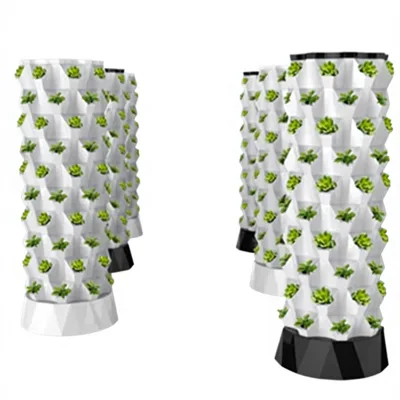
The physical configuration of these towers varies significantly. While the core keyword suggests a single tower unit, the observed product attributes reveal systems ranging from "Single" layer configurations to complex "6-10 Layers" vertical multi-layer designs. The "Vertical Garden Tower" models, such as those identified by model numbers like GN07, utilize a "Space Utilization" strategy that maximizes yield per square foot. These systems are designed for "Soilless Hydroponics," relying on an "Automated Nutrient Circulation" system that is often "Low Energy." The structural integrity of these towers is supported by "Steel Structure" in greenhouse applications, while the growing media itself may be encased in "Plastic Sheet" or "Plastic Greenhouse" environments. Buyers must verify that the specific tower model they select aligns with their intended crop load, as the data notes capacities ranging from 36 to 60 plants per unit.
Technical Specifications and Operational Parameters
The technical performance of a hydroponic tower is defined by its water management, lighting requirements, and pH compatibility. The supplied facts highlight a "Water System" characterized by "Automated Nutrient Circulation," which is a key differentiator from passive drip systems. This automation can be configured as "Semi-Automated or Fully Automated Options," allowing buyers to scale operations based on labor availability and budget. A critical efficiency metric provided is "Water Saving," with specific claims of "up to 90% Less Water" compared to traditional soil farming. This figure represents a significant operational cost reduction and environmental benefit, particularly for regions facing water scarcity.
Lighting is another pivotal technical specification. The towers are described as "Suitable for Natural or LED Light," offering flexibility for both indoor vertical farms and outdoor greenhouse setups. This dual capability supports the "Indoor & Outdoor" location attribute observed in the product data. The system's growth efficiency is tied to the "High Yield" potential, facilitated by the "Vertical Multi-Layer Design." However, buyers must pay close attention to the pH compatibility, which is specified as "5.5-6.5 Optimal." This narrow range is typical for nutrient solutions and requires the buyer to invest in reliable pH monitoring and adjustment tools to maintain plant health.
The physical dimensions and capacity are equally important for planning. The data lists "Small" size specifications alongside models capable of holding "36-60 Plants." The "Layer" count is a variable attribute, with some units being "Single" layer while others offer "6-10 Layers." This variability means that a "Food Grade ABS" tower might be a standalone unit or part of a larger modular system. The "Accessory" list confirms that a complete system includes a "Water Tank," "Net Pot," "Pipes," "Sponges," and a "Water Pump." These components are essential for the "Function" of the system as a "Water Hydroponic Growing System Tower." Buyers should ensure that the supplier provides all necessary accessories to avoid integration issues during installation.
Compliance, Certification, and Material Safety Verification
In the B2B procurement of agricultural equipment intended for food production, compliance and material safety are paramount. The core keyword "food grade" is a regulatory and health claim that requires rigorous verification. While the supplied facts mention "Food-Grade Durable Plastic," they do not explicitly list specific certification bodies like ISO 9001 or FDA compliance for the plastic resin itself. The "Low-confidence background" section notes ISO 9001, but the instructions strictly advise against using this for concrete claims. Therefore, buyers must treat the "Food-Grade" attribute as an observation that requires validation through supplier documentation rather than an automatic guarantee.
Buyers should request specific test reports or material safety data sheets (MSDS) that confirm the plastic resin meets food contact regulations in their target market. For instance, in the United States, compliance with FDA 21 CFR is standard, while the European Union requires compliance with EU Regulation No 10/2011. The supplied data mentions "Customized" standards and "Standard Packing," but it does not confirm adherence to international food safety standards. Consequently, the procurement strategy must include a clause in the purchase agreement requiring the supplier to provide third-party laboratory test results verifying that the tower material does not leach heavy metals or harmful substances into the nutrient solution.
Furthermore, the "Durability" attribute is listed as "Long Lifespan," but without specific years or warranty terms in the data, this remains a qualitative observation. Buyers should verify the UV resistance of the plastic, especially for "Outdoor" applications, to ensure the "Long Lifespan" claim holds true under direct sunlight. The "Standard" attribute is noted as "Customized," which implies that the manufacturing process can be tailored, but it also means that quality control protocols may vary between batches. A robust sourcing strategy involves auditing the supplier's quality management system to ensure consistency in material quality, rather than relying solely on the "Food-Grade" label.
Cost Drivers and Economic Considerations
The economic landscape of sourcing hydroponic towers is influenced by several variables, including material costs, automation levels, and scalability. The observed price range of 2.1 to 230 USD suggests a vast disparity in product complexity and scale. The lower end of the spectrum likely corresponds to single-layer units or basic components, while the higher end reflects fully automated, multi-layer systems with advanced nutrient circulation. The "MOQ range" of 1 to 1000 indicates that buyers can source small quantities for pilot projects or large volumes for commercial deployment. However, the "Low Energy" claim for the water system suggests that while the initial capital expenditure might be higher for automated models, the operational expenditure (OPEX) regarding electricity could be lower compared to non-automated systems.
Material costs are a primary driver, particularly for "Food-Grade Durable Plastic." The price of raw resin fluctuates with global oil prices, and the cost of "Steel Structure" for greenhouse integration adds another layer of expense. The "Modular Extension Available" attribute is a significant cost driver; buyers who plan to expand their operations later may prefer a modular design that allows for "Modular & Easy Assembly." This flexibility can reduce long-term costs by avoiding the need to replace entire systems when capacity needs to increase. The "Labor Saving" advantage mentioned in the product data is a direct economic benefit, as automated systems reduce the need for manual watering and nutrient management, which can be a significant portion of farm operating costs.
Buyers must also consider the "Packing" costs. The data lists "Standard Packing" and "Carton Package," but for international shipping, the cost of packaging and logistics can be substantial. The "Location" of the origin is "China," which implies specific shipping routes and potential tariffs that affect the landed cost. The "Lead time" is not explicitly provided in the data, but the "Customization" availability suggests that lead times may vary depending on the complexity of the order. Buyers should factor in the time required for custom manufacturing and the potential for supply chain disruptions when calculating the total cost of ownership.
Typical Applications and Crop Suitability
The versatility of food grade hydroponic towers makes them suitable for a wide range of agricultural applications. The supplied facts explicitly list "Leafy Vegetables, Herbs, Strawberries" as suitable crops. These plants thrive in the "Soilless Hydroponics" environment provided by the towers, which offer consistent nutrient delivery and optimal root aeration. The "Application" attribute further broadens the scope to include "Strawberry, Herbs, Flowers, Leafy Vegetables Plant," indicating that these systems are not limited to food crops but can also support ornamental plants. The "Suitable" category includes "Aquaculture, Mixed Farming, Seedling Cultivation, Vegetables," suggesting that these towers can be integrated into more complex farming ecosystems, such as aquaponics systems where fish waste provides nutrients for the plants.
The "Usage" attribute specifies "Production Greenhouse," which is a common setting for commercial hydroponic farming. However, the "Indoor & Outdoor" location capability means these towers can also be used in urban farming setups, rooftop gardens, or even residential settings. The "Department" attribute of "Plastic Greenhouse" and the "Roofing Shape" of "Shaped Roof" indicate that these towers are often part of larger greenhouse structures. The "Span" of "Multi" suggests that these systems can be arranged in rows or clusters to maximize space. The "Advantage" of "Land Saving, Water Saving and Labor Saving" is particularly relevant for urban environments where land is scarce and labor costs are high.
For commercial growers, the "High Yield" and "Space Utilization" features are critical. The "Vertical Multi-Layer Design" allows for the cultivation of "36-60 Plants" in a footprint that would typically support only a fraction of that number in traditional soil farming. This density is essential for maximizing revenue per square foot. The "Growth Efficiency" is further enhanced by the "Automated Nutrient Circulation," which ensures that plants receive consistent nutrition, leading to faster growth cycles and higher quality produce. The "Light Requirement" flexibility allows growers to utilize natural sunlight in greenhouses or supplement with LED lights in indoor facilities, providing adaptability to different climates and seasons.
Supplier Evaluation and Quality Control Protocols
Evaluating suppliers for food grade hydroponic towers requires a multi-faceted approach that goes beyond price comparisons. The "Customization" attribute is a key indicator of a supplier's flexibility and technical capability. Buyers should assess whether the supplier can accommodate specific design requirements, such as custom layer counts or specialized nutrient delivery systems. The "Standard" attribute being "Customized" suggests that the supplier is capable of tailoring products, but this also necessitates a rigorous quality control process to ensure that customizations do not compromise the "Food-Grade" integrity of the material.
Quality control should focus on the "Durability" and "Long Lifespan" claims. Buyers should request samples for physical testing, including impact resistance and UV stability tests, to verify the "Food-Grade Durable Plastic" claims. The "Installation" method, described as "Modular & Easy Assembly," should be tested for ease of use and structural stability. A supplier that provides clear assembly instructions and demonstrates a robust modular design is more likely to deliver a reliable product. The "Maintenance" attribute of "Low Maintenance" is another critical factor; buyers should inquire about the frequency of required maintenance and the availability of replacement parts like "Water Pump," "Pipes," and "Sponges."
The "Origin" of the products is "China," which is a major manufacturing hub for hydroponic equipment. However, buyers must be vigilant about the supplier's reputation and track record. The "Low-confidence background" regarding ISO 9001 suggests that buyers should not assume certification without verification. Instead, they should request evidence of quality management systems, such as audit reports or customer testimonials. The "Accessory" list should be verified to ensure that all necessary components are included and compatible with the tower system. A supplier that provides a comprehensive accessory kit reduces the risk of integration errors and ensures a smooth installation process.
Long-Term Procurement and Scalability Strategies
Sourcing hydroponic towers is not just a one-time purchase but a strategic decision that impacts long-term operational efficiency. The "Expansion" attribute, noting "Modular Extension Available," is a crucial factor for scalability. Buyers planning for growth should prioritize suppliers who offer modular designs that allow for easy addition of layers or units. This flexibility ensures that the initial investment can be expanded as demand increases, without the need for a complete system overhaul. The "Automated Nutrient Circulation" system's "Semi-Automated or Fully Automated Options" also play a role in scalability, as the system can be upgraded from a basic manual setup to a fully automated one as the farm grows.
The "Water Saving" capability of "up to 90% Less Water" is a long-term economic benefit that should be factored into the procurement decision. As water costs rise and environmental regulations tighten, the ability to conserve water becomes a competitive advantage. The "Low Energy" attribute of the water system further supports long-term cost savings, reducing the operational burden on the farm's energy infrastructure. The "High Yield" and "Growth Efficiency" attributes ensure that the farm can maximize its output, providing a strong return on investment over time.
Buyers should also consider the "Durability" and "Long Lifespan" of the towers when planning for long-term procurement. A product with a longer lifespan reduces the frequency of replacement and the associated downtime. The "Food-Grade" material ensures that the towers remain safe for food production throughout their lifecycle, avoiding the need for costly replacements due to material degradation. The "Modular & Easy Assembly" feature also contributes to long-term value by making it easier to repair or replace individual components without dismantling the entire system.
In conclusion, sourcing food grade ABS hydroponic towers requires a comprehensive understanding of the technical specifications, material safety, cost drivers, and long-term scalability. By carefully evaluating suppliers and verifying the "Food-Grade" claims, buyers can ensure that their investment in hydroponic technology delivers the promised benefits of high yield, water savings, and operational efficiency. The flexibility of the "Modular Extension" and "Automated Nutrient Circulation" systems makes them ideal for both small-scale and large-scale agricultural operations, providing a sustainable solution for modern farming challenges.
FAQs
What crops are suitable for this hydroponic tower system?
The system supports leafy vegetables, herbs, and strawberries. It is also suitable for growing flowers and can be used in mixed farming or seedling cultivation environments.
How much water does this vertical tower save compared to soil?
This system saves up to 90% less water than traditional soil farming. The automated nutrient circulation system ensures efficient water usage while maintaining plant health.
Can I customize the layer count and plant capacity of the tower?
Customization is available for layer counts ranging from single units to 6-10 layers. Capacities typically support 36 to 60 plants depending on the specific modular configuration selected.
What material is used to ensure food safety for edible crops?
The towers are constructed from food-grade durable plastic to prevent chemical leaching. This material ensures safety for growing edible crops like strawberries and leafy greens.
Is the nutrient circulation system fully automated or semi-automated?
The system offers both semi-automated and fully automated options for nutrient circulation. These low-energy systems reduce labor costs while ensuring consistent plant nutrition delivery.
Where are these hydroponic towers manufactured and shipped from?
The products originate from China and are available for both indoor and outdoor use. Standard packing includes necessary accessories like water tanks, pumps, and net pots.